
 Modibbo Kawu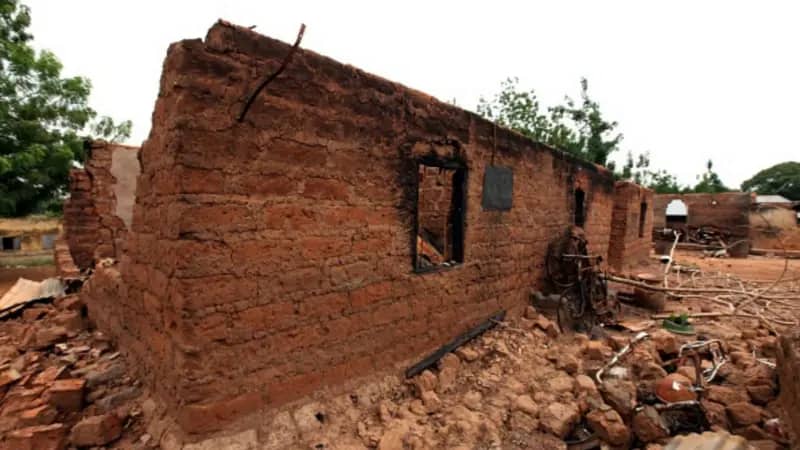
In the early hours of Wednesday, February 4th, 2026, news broke of the tragic killings of dozens of people in the outlying communities of Woro and Nuku in the Kaiama Local Government Area of Kwara State.
The earliest reports from online platforms gave conflicting numbers of casualties from the attack. Some reports claimed that up to 160 people had been brutally massacred by assailants allegedly numbering up to 200, who had emerged from the neighbouring Kainji Lake National Park. The attackers were linked to a Sadiku-led Boko Haram faction operating across parts of the North Central and Sahel regions.
As of Wednesday morning, the local village head of Woro community, Alhaji Salihu Bio Umar, was said to be missing, while his palace was razed to the ground. The heavily armed terrorists stormed Woro community on Tuesday evening around Maghrib prayers time, unleashing coordinated attacks on residents and homes.
Some of the more than 160 people reportedly killed during the onslaught, included two wives of the village head, several of his children, the Chief Imam of Woro, a school principal, and a headmistress. Students returning home from school were not spared, as many were allegedly killed in their homes and on the streets.
Residents were quoted as saying the attackers went from house to house, shooting indiscriminately and slaughtering victims at close range. Some victims were reportedly killed with machetes, while others had their throats slit.
A related report noted that the traditional ruler of the community, Alhaji Salihu Bio Umar, had reported threats he and his community received from the terrorists to security operatives. That raised concerns that the attacks might have been reprisals for the steps taken to report the actions of the assailants.
The attack was one of the deadliest assaults recorded this year in Kwara State, which has been ravaged by spiking cases of banditry, kidnapping amidst other security challenges that Northern Nigeria has faced in recent years.
While the actual number of victims was still not very clear, early on Wednesday morning, Hon. Ahmed Saidu Baba, representing the Gwanabe/Gweria/Bani/Adena constituency in the Kwara State House of Assembly, told Reuters that at least 170 people were killed during the attack.
An online platform quoted a local journalist, who identified himself as Kaiama TV, as stating that “the actual number of victims is yet to be confirmed because search is still going on”, adding that “We personally recorded 162 around 12pm today”.
Much later in the day, the picture of the situation became clearer, when the Kwara State Governor, Abdulrahman Abdulrazaq, paid a condolence visit to the Woro community as well as the Emir of Kaiama.
Abdulrazaq told his audience that: “At least 75 local Muslims were massacred in cold blood simply for refusing to surrender to extremists who preached a strange doctrine”.
That same note was struck by the Nigerian presidency. Bayo Onanuga, presidential spokesperson stated that “the President expressed particular outrage that the attackers killed members of the community who had reportedly resisted attempts to indoctrinate them into extremist ideology.
According to the Presidency, the terrorists resorted to violence after the villagers rejected their radical teachings and insisted on practising Islam in a manner rooted in peace, tolerance and dialogue.
“It is commendable that the community members, even though Muslims, refused to be conscripted into a weird belief that promoted violence over peace and dialogue,” the President was quoted by his spokesperson.
Governor Abdulrahman Abdulrazaq, who had been accompanied to Kaiama by service chiefs and some members of his government, then announced to the Kaiama community that President Tinubu had approved the deployment of a battalion of Nigerian soldiers into the community. That is in a counter-insurgency operation codenamed “Operation Savannah Shield”.
The village head, Alhaji Salihu Bio Umar, who had been reported missing in earlier reports of the incident, was the one who received the governor in Woro. Governor Abdulrahman Abdulrazaq also directed the State Emergency Agency to provide relief materials to the survivors in the communities. It was instructive that the state and federal governments were very proactive in their response to the tragic killings in Woro and Nuku communities of the Kaiama Local Government Area.
But there are far more serious underlying security and socioeconomic challenges that need further interrogation.
Firstly, was it true that the village head reported the activities of the Boko Haram faction to the security forces? If so, what was the nature of reaction and the analysis of the threat posed by the assailants? Why was the community left to its fate in the hands of the killers? If cooperation with the security forces leads to the scale of massacre witnessed in Woro, it is likely that other traditional rulers and people in vulnerable communities might conclude that the best way to save themselves is to keep quiet or more ominously, cooperate with marauding assailants.
From what has been pieced together so far, the assailants in Woro were apparently not “bandits”, which often connote an ethnic definition. State authorities have linked the massacre to doctrinal excesses on the part of a “Boko Haram faction”. That group was said to have fanned out of the Kainji Lake National Park. It means that a very active faction of Boko Haram has taken advantage of the manner that our national parks seemed to have transitioned into ungoverned spaces in recent years. They now use those redoubts to launch attacks on communities, to recruit new disciples, to provision for their membership, and to hide.
I know that in the past year, the Office of the National Security Adviser has actively worked on the training and equipping of forest rangers for Nigeria’s national parks. However, there is a national imperative to rethink the budgeting for national parks as well as their security. These are genuine national treasures that were a product of patriotic thinking and execution when they were created from the 1970s.
Today they are ghost institutions in many instances. They’re not properly budgeted for, and until recently, they are not effectively policed. They became sanctuaries for Boko Haram and other non-state actors who live outside of a lawful relationship with the state and civil society.
Kwara State is in a particularly difficult situation. It is the location of the Kainji Lake National Park, the Old Oyo National Park, it is not far from the Kamuku National Park, and it is home to very expansive, very difficult to govern, natural forested regions of Kwara North, in the Baruten, Kaiama, and into the Edu, and Moro local government areas.
It is therefore a good first step, that the Nigerian government has approved the deployment of a military battalion to that part of Kwara State. That will immediately impose the kinetic elements of defence strategy in counter-insurgency in those communities of Kwara North. As a first step, it is very necessary.
The people in vulnerable communities need the reassurance of visible security presence with regular route assessment patrols; territorial surveys; area dominance exercises; forest patrols, etc. These will help to properly target the non-state actors that violently attack vulnerable communities. They will then, hopefully, be neutralized, captured or eliminated. That will impose the peace that can allow peasant communities and pastoralists to go back to their livelihoods.
The non-kinetic elements of defence, in the long run, will have to explore the power of the state and its abilities to intervene in socioeconomic provisioning for the Nigerian people. The continued implementation of neoliberal policies is Einstein’s definition of madness. Doing the same thing over and over and expecting a different outcome. The Nigerian ruling class’ near-religious devotion to implementing these policies, has managed to create a country in despair. Our country is now one of the most unequal, and most unjust societies on earth.
Nigeria’s neoliberal capitalism has transferred public wealth into the hands of private individuals, in a string of dubious privatization programmes that didn’t improve national productive forces. Our bizarre form of capitalism is not creating the jobs to absorb millions of young people who are frustrated and angry, and have become the reserve army of a hopeless underclass available for recruitment by different non-state groups.
If we don’t create a caring society that works for the young people who constitute the majority of our population today, while we continue to prioritize elite privileges, our country will not stop the harvest of emboldened criminality, the type that led to the massacre of so many innocent people in the Woro community of Kaiama Local Government Area of Kwara State. Unfortunately.
Ilorin, Thursday, February 5th, 2026.
Is’haq Modibbo Kawu, FNGE, holds a PhD in Defence and Strategic Studies from the Nigerian Defence Academy.